In Part 1(https://aiforproduction.blog/2026/02/22/will-jobs-exist-as-we-knowthe-fear/) , we saw something uncomfortable. An AI agent was able to independently build a model — potentially better than a human-built solution — and even generate a GDPR compliance report.
At first glance, the conclusion seems obvious: AI automates coding → developers disappear.
But that assumption misses something important. Building the model was never the entire job. It is just one layer in a much larger system.
So before we panic about jobs disappearing, a better question is:
How does work actually flow inside an organization — and how is AI changing that flow?
Let’s zoom out and relook at the Churn Problem.
Take the same churn problem from Part 1.
Reduce customer churn in an OTT subscription platform from 10% to 2% within the next Quarter

To understand how work actually happens inside organizations, we can break the system into five layers. Solving this problem is a strategic, financial, legal, product, and engineering decision.
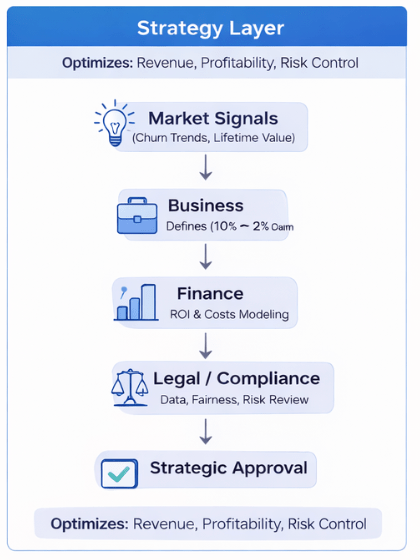
LAYER 1:(Strategy)
Defines which problems are worth solving. AI systems are increasingly helping teams simulate business outcomes before investments are made.
Key responsibilities
• Identify revenue opportunities such as reducing churn or increasing customer lifetime value.
• Translate market signals into business goals
• Define measurable outcomes (e.g., churn reduction)
• Evaluate ROI, risk, and strategic fit
Teams
• Business leaders and executives
• Finance and strategy teams
• Legal and compliance leaders
Optimizes for
• Revenue growth
• Profitability
• Strategic alignment
• Risk control
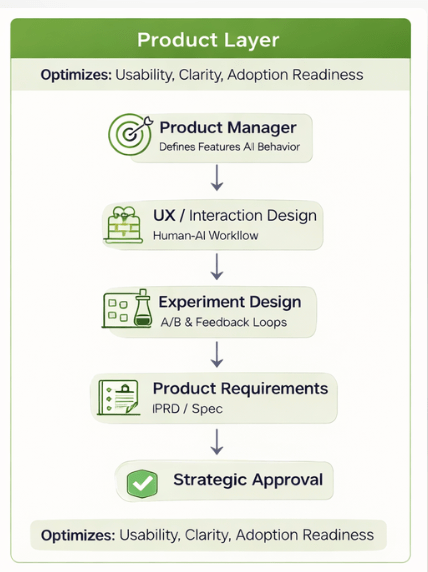
LAYER 2:(Product and Design)
Translates strategy into product experiences and system designs.
Key responsibilities
• Define product features and system behavior
• Design user journeys and interaction flows
• Create product requirements and specifications
•Define hypotheses to test through experimentation.
Teams
• Product managers
• UX and interaction designers
• Product analysts
• Experimentation teams
Optimizes for
• Usability
• Clarity
• Adoption readiness
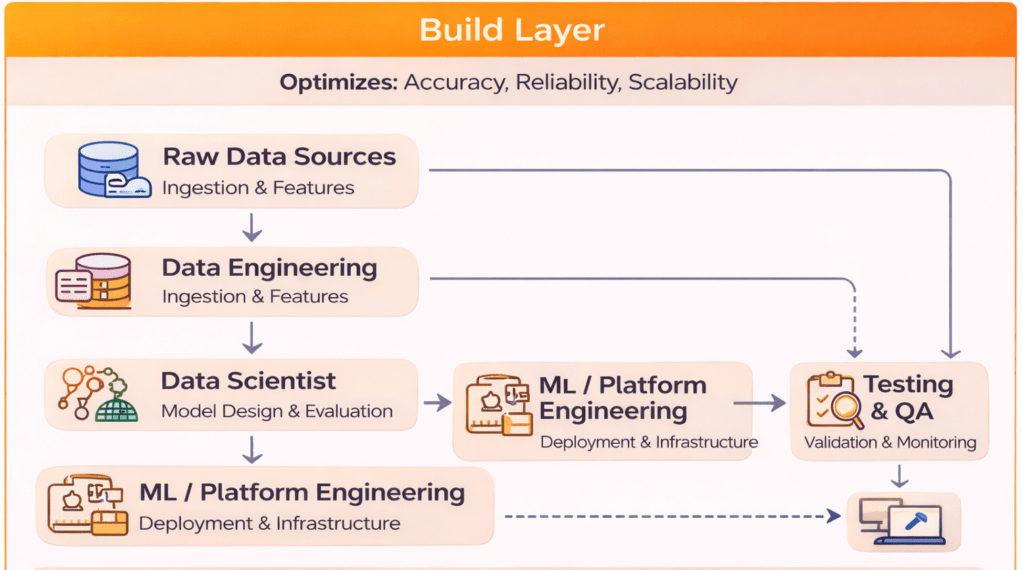
LAYER 3: (Build & Data)
This layer turns product ideas into reliable systems — connecting data pipelines, models, APIs, and infrastructure into production services.
Key responsibilities
• Develop backend services and APIs
• Build data pipelines and storage systems
• Train and deploy machine learning models
• Operate infrastructure, deployment, and testing pipelines
Teams
• Software engineers
• Data engineers
• Machine learning engineers
• Platform / DevOps engineers
• QA and testing engineers
Optimizes for
• Accuracy
• Reliability
• Scalability and Performance
This is the layer where most visible AI disruption is happening because it involves code, data analysis, and model training — tasks AI can accelerate dramatically.
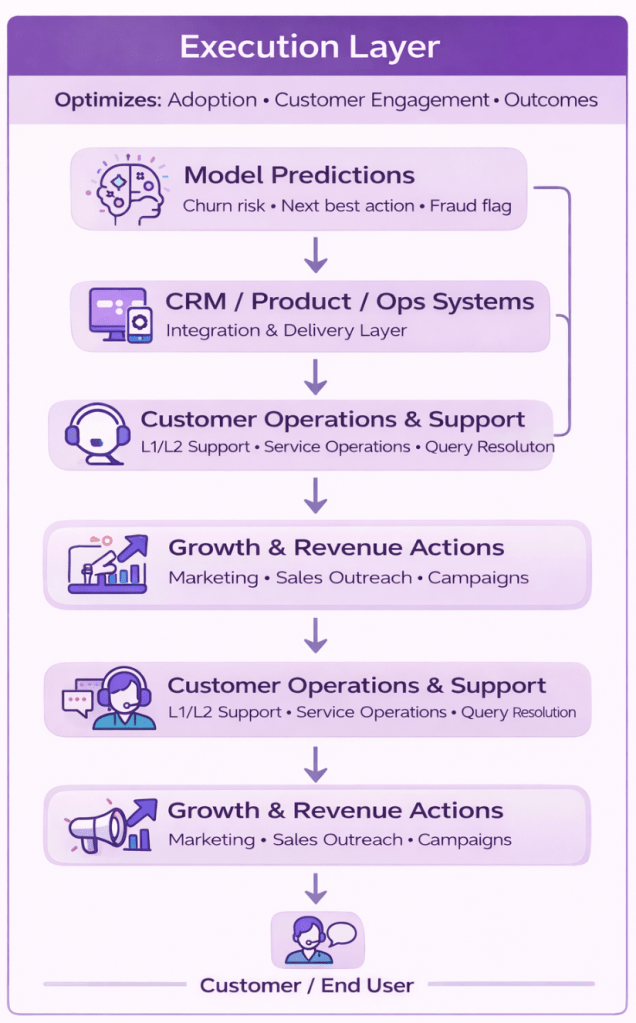
LAYER 4: Execution
Delivers product capabilities, predictions, and insights to users and operational teams.
Key responsibilities
• Deliver AI-powered predictions and features to users
• Trigger campaigns, workflows, and operational interventions
• Resolve customer issues and support interactions
• Monitor user behavior, outcomes, and system performance
• Capture feedback and performance signals
Teams
• Marketing
• Customer success
• Sales and revenue operations
• Customer support (L1 / L2)
• Customer/service operations
• Growth and lifecycle teams
Optimizes for
• Adoption
• Customer engagement
• Outcome effectiveness
LAYER 5: Control (System Integrity):
Control Layer
Ensures systems operate safely, reliably, and in alignment.
Key responsibilities
• Define architecture standards and technical governance
• Manage AI risk, bias, and compliance
• Protect data, access, and system security
• Ensure reliable experimentation and measurement
• Coordinate initiatives across teams and systems
Teams
• Engineering leaders and architects
• Technical program managers
• AI governance and risk teams
• Security and privacy teams
• Analytics and experimentation leaders
Optimizes for
• System integrity
• Organizational alignment
• Safety and compliance
• Measurement reliability
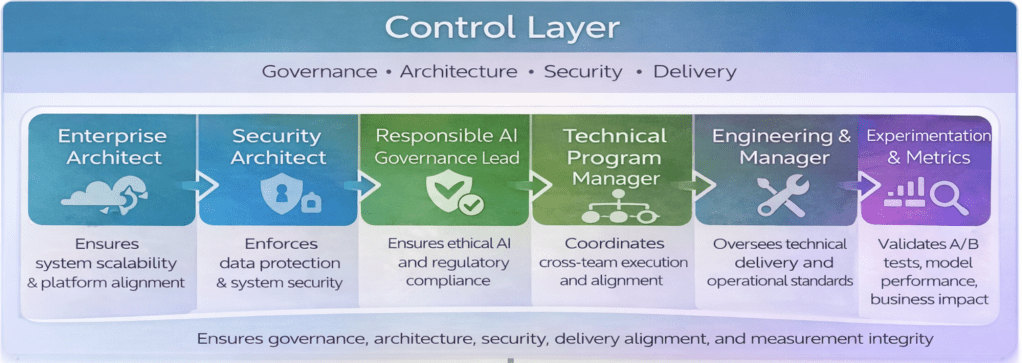
These are folks who work across the layers to ensure the systems function the way they are supposed to.
What Is Actually Changing?
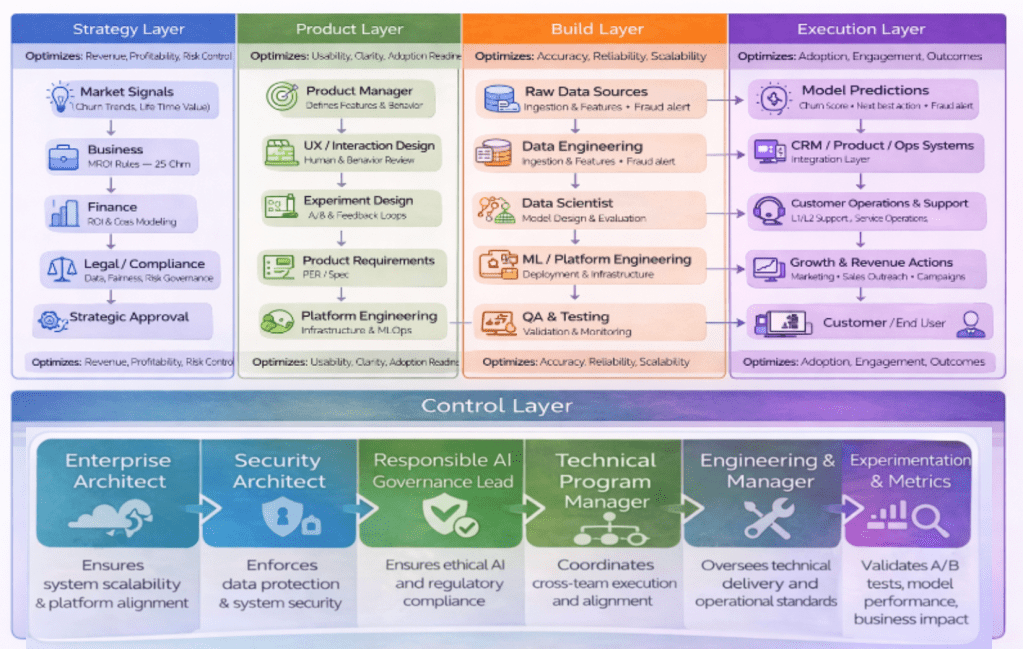
Looking across the layers we explored, it becomes clear that AI is not disrupting just one part of the system.
The most visible changes are happening in the Build & Data layer, where coding, data analysis, and model development are accelerating rapidly.
But the deeper shift goes beyond engineering.
AI is reducing the effort required to move work from idea to execution.
Historically, work inside organizations flowed through multiple layers:
Strategy → Product → Build → Execution
Each step required specialized teams, coordination, and often months of effort to move from problem to outcome. With AI, that equation begins to change.
Strategy → (AI-accelerated execution) → Outcomes
asks that once required large teams can now be executed by smaller groups augmented with AI systems.
Work that previously required 20 people may now require 5 — not because the problem disappeared, but because the cost of execution has fallen dramatically.
And when execution becomes cheaper, the structure of work itself begins to change
The Real Shift
What AI is really doing is compressing the effort required to execute work while accelerating decision-making.
When execution becomes dramatically faster and cheaper, something deeper begins to change. Organizations start to rethink how work is structured, how teams operate, and where value is actually created.
The conversation moves from:
“AI replaces jobs.”
to
“AI changes where value is created inside organizations.”
When execution becomes dramatically cheaper, the most valuable skills shift toward:
- identifying the right problems
- designing systems
- orchestrating AI capabilities
- ensuring reliability and trust
The future of work may not eliminate engineers. But it will likely reshape what engineering actually means. That is the shift we will explore in the next article.

 AI For Production