As GEN AI evolves, multi-agent systems (MASs) are gaining traction, yet many remain at the PoC stage. So this is where research papers and surveys help. Over the weekend, I explored their failure points and found a fascinating study worth sharing.
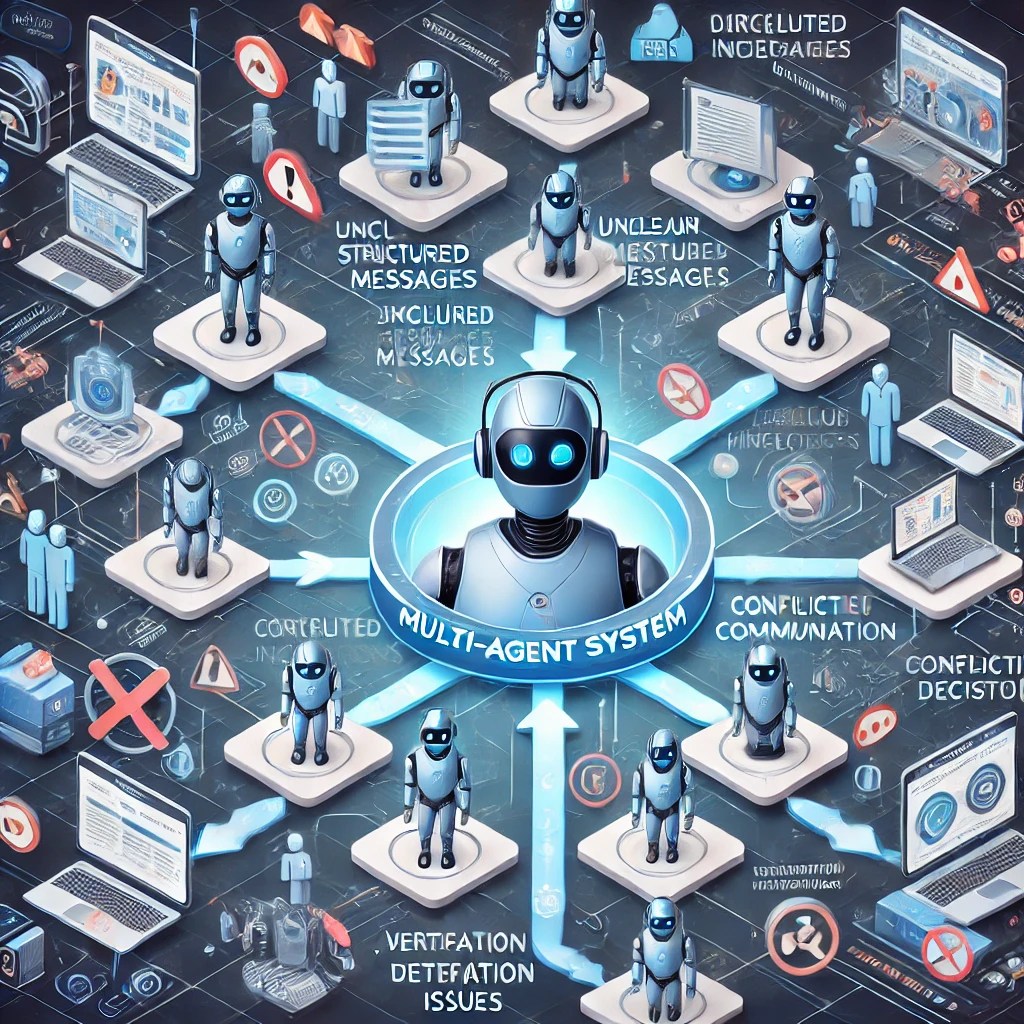
MASs promise enhanced collaboration and problem-solving, but ensuring consistent performance gains over single-agent frameworks remains challenging. A recent study categorizes failure modes in MASs, providing valuable insights into why they often fall short.
Key Failure Modes in Multi-Agent Systems
The research identifies three primary failure areas:
1. Specification & System Design Failures (37.17%)
- Unclear task instructions and agent roles
- Ineffective conversation management, leading to loss of context
- Agents failing to adhere to predefined task specifications
2. Inter-Agent Misalignment (31.41%)
- Ineffective communication and information withholding
- Conflicting behaviors leading to misalignment
- Failure to seek clarification or incorporate other agents’ input
3. Task Verification & Termination Issues (31.41%)
- Premature termination of processes
- No or incomplete verification mechanisms
- Incorrect validation of task completion
How Can We Address These Failures?
Short-Term (Tactical) Fixes
🛠 Improved Specification & Design
- Define agent roles and responsibilities clearly.
- Use structured prompts and self-verification steps.
- Design conversation frameworks for better coordination.
🔄 Enhancing Inter-Agent Collaboration
- Implement cross-verification mechanisms.
- Use structured conversation patterns to improve teamwork.
- Design modular agent architectures for simplified interactions.
While these fixes have shown measurable improvements (e.g., a +14% accuracy boost in ChatDev), they don’t solve all issues.
Long-Term (Structural) Solutions
✅ Enhanced Verification Mechanisms
- Develop automated unit test generation for MAS domains.
- Implement robust quality assurance frameworks.
🗣 Standardized Communication Protocols
- Move beyond unstructured text-based communication.
- Define clear intentions and structured parameters for inter-agent dialogue.
🎯 Reinforcement Learning for Agent Behavior
- Use role-specific RL algorithms to fine-tune agent actions.
- Encourage task-aligned decision-making and penalize inefficiencies.
🤖 Uncertainty Quantification
- Introduce probabilistic confidence measures for better decision-making.
- Help agents assess when to act vs. when to seek input.
🧠 Improved Memory & State Management
- Enhance long-term context retention.
- Ensure reliable tracking of progress over extended interactions.
The Road Ahead
This study highlights that incremental fixes aren’t enough—MASs need fundamental design improvements. Future research should focus on:
- Better evaluation benchmarks for MAS performance
- Enhanced agent communication models to reduce ambiguity
- Advanced AI techniques for improved collaboration
With an open-sourced dataset and LLM annotator, this research lays a strong foundation for scalable and reliable multi-agent collaboration in AI.
Paper Link: Multi agent systems failure taxonoty
What Do You Think?
What other strategies could improve Multi-Agent LLM Systems? Let’s discuss in the comments!

 AI For Production