Over the last few years having worked on the production side of AI I have had the experience working with a few AI/ML initiatives. Some have made it to production and a lot have not made it to production. Failures happen at multiple stages :-
- Inception stage: idea proposed from products team and dropped for any reason. Eg. Video analysis for user segmentation in shopping complex
- Data analysis stage : Before any ML model is being built, the first stage is generally running some analysis on data to understand the patterns, doing some hypothesis testing. Eg. Cart abandonment analysis. Ideas do get dropped post this stage as well.
- Poc Stage : V1 of AI system is built and post demo for business users, business decides to not move ahead to production.
- Beta Product Stage: AI system is deployed to prod/pre-prod and after testing with a small subset of users , the AI system is scrapped.
- Post Production Stage : AI system is deployed to production and exposed to complete traffic and phased out after a period of time.
A lot of the above happens primarily due to few aspects:-
- Not clearly understanding of the business problem being solved
- Not clearly defining how the solution benefits the organisation
- This system not generated the estimated ROI or ROI might have been overestimated.
- Business users not able to the understand value generated from the system due to lack of metrics from system.
This problem would be something that leadership side across science, engineering, products and business needs to have it clearly understood so as to align the product towards achieving proper ROI.
AI USE CASE TEMPLATE:
Taking all of our learnings we can actually create a template to understand the 30,000 ft of our AI initiative that we propose.
(source: https://community.nocode.ai/c/the-ai-bootcamp)
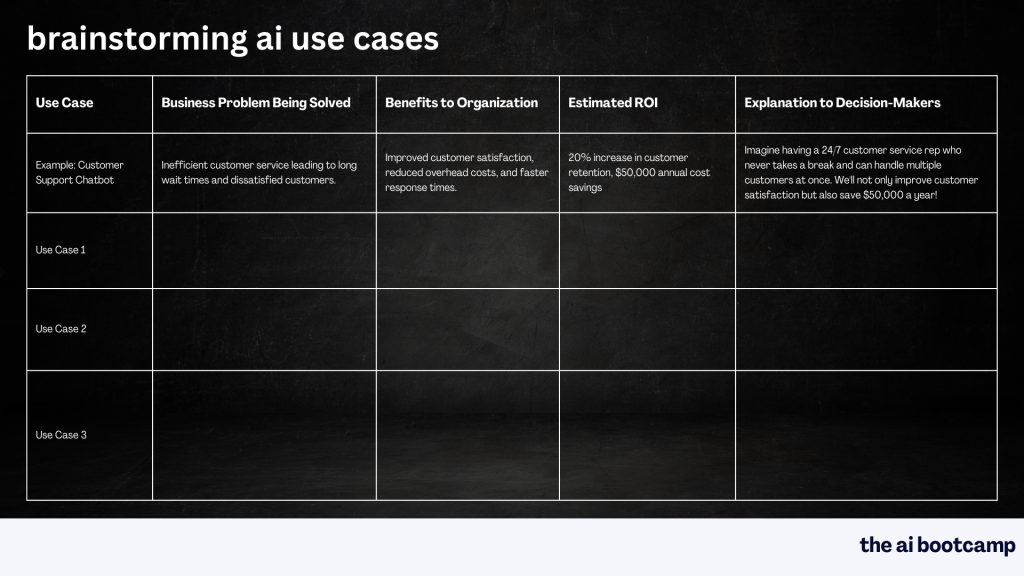
Starting with this or even trying to fit in your existing AI use cases might be an interesting exercise that would help align all stakeholders to be invested in a particular AI initiative.

 AI For Production